Saturday, April 25, 2026

Recent Thoughts

Most recently I have been thinking about how I titled my pictures. Currently, they all are "Untitled #xxx" as a way to identify them and not lead the viewer, but instead allow them to interpret and 'read' the picture as they wish. Now, my thinking is to title the pictures as "Observations xxx" as a more exact titling mechanism.

The thinking behind this revised titling is to separate the art titling from any convention and invent a new system of titling. Additionally, I think it is a more accurate way to title my work. I view the pictures I create more as "observations" than simply capturing a scene and giving the usual "untitled" identifier. This new mechanism of titling may also help viewers to understand and interpret the work.

"Observations" may be reserved for a certain genre of series I am developing; e.g. contemporary ruins, earthworks, urban landscapes, urban sculptures, night prowling, etc. 

The "Untitled" identifier may still be used for the current series.

All this still remains to be seen as the images get created.

Observation #367


Sunday, November 2, 2025

Monday, June 3, 2024

New artist photobook, click link to preview the book: GARDEN CITIES 

Or click image below to watch the book video.

Garden Cities cover


Garden Cities is a self-published artist photobook that includes seventy-five color pictures. This project looks at the question of the role of "green spaces" in cities and what does it mean to have a verdant aesthetic in the built environment?

Other publication by Philip Malkin

Tuesday, October 5, 2021

Interiors

Interiors is the latest artist book created by Philip Malkin Fine Arts, Click the image below to preview the book.

Interiors


Tuesday, March 23, 2021

archimageArt

I embarking on a new journey. Today I began work on another project; archimage ART. This website will hold the more experimental work I am experimenting with. Admittedly, it is being inspired by all the web chatter about NTFs (non-fungible token). I am just dipping my toe into this genre of art making. Please take a look at the new web site and let me know your thoughts. A work in progress.

archimageART.com

Sunday, March 7, 2021

Topics for this Year

 I have a website, an Instagram page, a Twitter page, and this Blog. I don't get many visitors to any of them, usually my friends and family. Every once in a while someone I do not know comes by and visits one of these sites. I have been doing this for quite some time as a means to get my art out into the world.

I also submit my art work every once in awhile to "call for art" that galleries post. This is a source of great frustration since out of 10 submittals, my work may be accepted by one or two galleries. So this year, 2021 I am going to try and post to this blog more frequently as a means to generate more interest in my art work. Following are a list of topics I have been thinking about to write in this blog, not necessarily in any order or priority:

  • Art projects in process
  • Making photobooks and why
  • Color vs black and white photography
  • The photo image as art work (this will be primarily about my work)
  • Photo art aesthetics
Assuming someone reads this, I am open to suggestions.

Wednesday, December 30, 2020

for the love of Photobooks

I have been collecting photobooks for about forty years. I love the way they feel and the intimate viewing distance looking at one. The photographs presented in a book is so much different than when viewing one on a wall in a gallery or museum. How the photographs are sequenced provide a very different "narrative" than any one photograph by itself. This essay by Teju Cole, "In Praise of the Photobook" sums up many of the reasons why a photobook is unique.

Monday, October 19, 2020

Book: Hand Tools (a sampler)

New book created this past summer during the COVID-19 pandemic. Click the image to preview the book.


Sunday, August 16, 2020

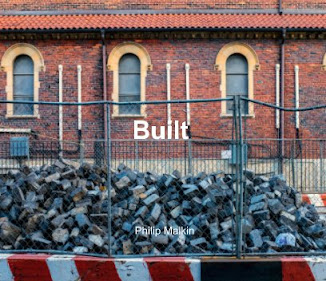
Book: Built

Published this month, August 2020. Click on image to preview the book.


Built

Saturday, December 22, 2018

Saturday, February 4, 2017

Politics 2017
I find myself preoccupied by what is going on in the USA. This is the first of a new series.

Fenced

Saturday, September 20, 2014

Americans

A new series from my last visit to New York City.


More can be viewed here on my web site,

Sunday, September 9, 2012

Food Series

Something new that I am working on.

"Pistachio - 2012"

"Almond - 2012"
"Chip" - 2012

Saturday, April 28, 2012

Obsolete

 Sitting around my studio, looking at all the stuff on my shelves and scattered around, I realized that there is stuff that no body uses any more. A new photo project emerges. I am now fascinated by obsolete objects. It is amazing to me how much stuff has gone obsolete in just the past few years. Ok, maybe it is more than a few years. Here are some samples:


Saturday, May 7, 2011

World on View


Finally, I put a book of photographs out for the world to see. Title of the book: World on View. Now I wait for feedback from my friends and colleagues. I am still considering adding an introduction if someone steps forward with thoughts that can add to this oeuvre.

I am still very close to the work. Perhaps I will add to this post in time.

Monday, March 7, 2011

E-photobooks

Where are the e-photobooks? There has been a lot of discussion about the future of the photobook, but then why is there no e-books that focus on the art of photography? As I have been spending a fair amount of time creating a new photobook of my own work, it has dawned on me that maybe I should be creating an e-book.

I know all the arguments for the creation of photography books. But now with the advent of devices like the iPad, why not have e-books that can be held and have a similar intimate experience as holding a book? The aesthetics of this medium is yet to be explored, to my knowledge.

I am not sure of the business for e-photobooks, but why can they not be similar to any other e-book that is sold? There may be a new audience for this type of photography. The traditional photography book is a very personal experience that the viewer has with the work. The e-photobook can have a similar experience and maybe even an expanded shared experience as the e-photobook is 'sampled' when e-mailed to friends and family.

As photographers and photobook makers, we need to begin to explore the current and future technology of publishing. As we have seen the change in the written word moving to new platforms, the photograph must follow. Digital photography is the perfect source to move in this direction. It is not an either or, but both. Print and e-book. Let there be e-photobooks.

Sunday, July 4, 2010

Lime Works

I am not sure why, but lately I have been drawn to Japanese photography. I am finding the aesthetic of these photographers fascinating. They present their world through photography very differently than western photographers. Perhaps it is because of the history of Japanese art and calligraphy that influences these photographers, similar to how western painting influences European and American photographers.

Recently I came across the works of Naoya Hatakeyama in a book of his photographs called Lime Works. At first glance the photographs are similar to the works of Edward Burtynsky's Quarries presenting similar intensity of how man has imposed himself carving the earth with giant machines. Hatakeyama takes a different perspective, however. His images have an abstract quality that both is surreal and at the same time engaging. The scale and size of the factories from Hatakeyama's point of view appear intense and chaotic. The texture of the surfaces combined with the light of these color photographs are not like anything seen before. Turning the pages of this book leads one on a journey into a world most of us have never seen. The complex jumble of industrial shapes inserted into a landscape appears like science fiction.

Then without warning, the book gives you a breather. Several pages of photographs of lime powder covering everything. You are now inside the lime works. Every surface is white with lime dust. As you peer at each photograph, you wonder, why are there no foot prints? I was struck by Hatakema's images that he never shows people or their presence. Yet, they are always there somehow.

The final journey in this book takes you again outside. This time to the dig sites. More images of disorienting landscapes, but without the industrial hardware. These photographs are beautiful, seemingly off planet vistas of what the lime works leave behind after carving the earth. They have a peacefulness to them while at the same time being slightly on the edge of comfort. Similar to the other images in the book, the theme is seeing (and not seeing) how we humans scar the earth.

A truly enjoyable book of photography!

Saturday, June 19, 2010

The Modern Century


I finally got around to looking at the book I picked up at MoMA from the the Henri Cartier-Bresson show. This show was outstanding. Over 300 photographs by the master, spanning his career. Actually, it was a bit overwhelming. That is why, not surprising, I decided to buy the book and view this collection of a his life's work from the leisure of my home.

We all know how great Henri Cartier-Bresson (1908-2004) was as a photographer. Looking at this incredible book, The Modern Century, is like holding greatness in one's hands. From the essays by Peter Galassi, chief curator for the department of photography at MoMA, to the superb reproductions of the photographs, this book is wonderful. It not only has the great photographs that has made Cartier-Bresson world famous; e.g. Sunday on the banks of the River Marne, 1938 it has surprises throughout. Photographs that are incredibly powerful but not as well known; e.g. Wrestlers on Independence Day, Ulaanbaatar, Mongolia, 1958.


Sunday on the banks of the River Marne, 1938. © Henri Cartier-Bresson / Magnum Photos

This book of Cartier-Bresson photographs is a masterpiece also because of the care in how it is assembled. It is more than a catalog of the exhibit and his oeuvre. The images are placed together in sections that are thematic. Then within each chapter the sequencing of photographs are very thoughtfully arranged to augment the story each individual image conveys. I found myself transfixed with each page to the next. Yes, the photographs are powerful, but credit must be awarded to the editors as well. This book is destined to become a great source for students of Cartier-Bresson, photojournalism, and the art of bookmaking.

This exhibit is on view at MoMA only until June 28. If you are in NYC or plan to visit, this show is a must see. If you miss the exhibition, there is always the book, which should be in your library any way.

More information: Foundation Henri Cartier-Bresson